








Buying vs Renting House: 7 Smart Tips for a Better Choice:
Buying vs Renting House in India: Buying a home is one of the biggest financial decisions many Indians will make, but does owning a property always make more financial sense than renting? Not necessarily. The right choice depends on your income, savings, home loan eligibility, location, expected length of stay and long-term financial goals.
- Buying vs Renting House: 7 Smart Tips for a Better Choice:
- Buying vs Renting House: Key Differences at a Glance
- Buying vs Renting House: Key Differences
- What Does India’s Housing Market Tell Us in 2026?
- The Real Cost of Buying a House in India
- Rent vs Buy House Calculator India: An Illustrative Financial Comparison
- Rent vs Buy House Calculator: Assumptions
- Home Loan Cost Breakdown
- How Rental Yield Helps Compare Buying vs Renting House
- Advantages of Renting a House vs Buying
- Advantages of Buying a House Over Renting
- Is Buying Better If You Plan to Stay for Five, Ten or Twenty Years?
- How to Make a Fair Rent vs Buy House Calculator India
- Should You Invest the Money Saved by Renting?
- How Much EMI Can You Afford?
- Home Loan Tax Benefits: Check the Rules Before Assuming Savings
- Buying vs Renting a Home in India: Which Option Is Right for You?
- A Practical Checklist Before You Decide
- Frequently Asked Questions (FAQ)
- Is buying vs renting house better in India in 2026?
- What is the biggest financial advantage of renting?
- What is the biggest advantage of buying a house?
- Does paying rent mean wasting money?
- Is EMI always better than rent?
- How do I calculate Buying vs renting house ?
- What is rental yield, and why does it matter?
- Should first-time homebuyers buy a house or rent first?
- Final Verdict: Make the Decision With Your Numbers
When comparing buying vs renting a home in India, looking only at monthly rent and home loan EMI can lead to the wrong conclusion. Homeownership also involves a down payment, stamp duty, registration, maintenance and the opportunity cost of money invested in the property. Renting, meanwhile, offers flexibility and may allow you to invest money that would otherwise be tied up in a home.
India’s housing market also varies considerably between cities. Property prices, rents, rental yields and affordability can differ significantly between Delhi-NCR, Mumbai, Bengaluru, Pune and Ahmedabad.
This guide examines the financial and lifestyle trade-offs, uses illustrative calculations, compares city-level rental yields and explains how to decide whether buying or renting is more suitable for your circumstances in 2026.
Buying vs Renting House: Key Differences at a Glance
Before looking at detailed calculations, understand how the two options differ:
Buying vs Renting House: Key Differences
Compare the costs, flexibility, ownership, and long-term considerations.
| Factor | Buying a House | Renting a House |
|---|---|---|
| Initial cost | Down payment, registration, stamp duty and other purchase costs | Security deposit, brokerage where applicable and moving costs |
| Monthly payment | Home loan EMI, maintenance and other ownership expenses | Rent, maintenance charges where applicable and utilities |
| Ownership | Builds ownership equity as the loan is repaid | Does not build equity in the rented property |
| Flexibility | Selling or relocating can take time and money | Usually easier to relocate at the end of a tenancy |
| Property appreciation | The owner may benefit if the property value rises | The tenant does not receive property appreciation |
| Maintenance | Major repairs and ownership costs generally fall on the owner | Responsibility depends on the rental agreement and local rules |
| Investment opportunity | A substantial amount of capital may be tied up in the home | Savings may be available for other investments |
| Long-term security | Can provide greater control over the home, subject to loan obligations | Depends partly on the tenancy agreement and landlord relationship |
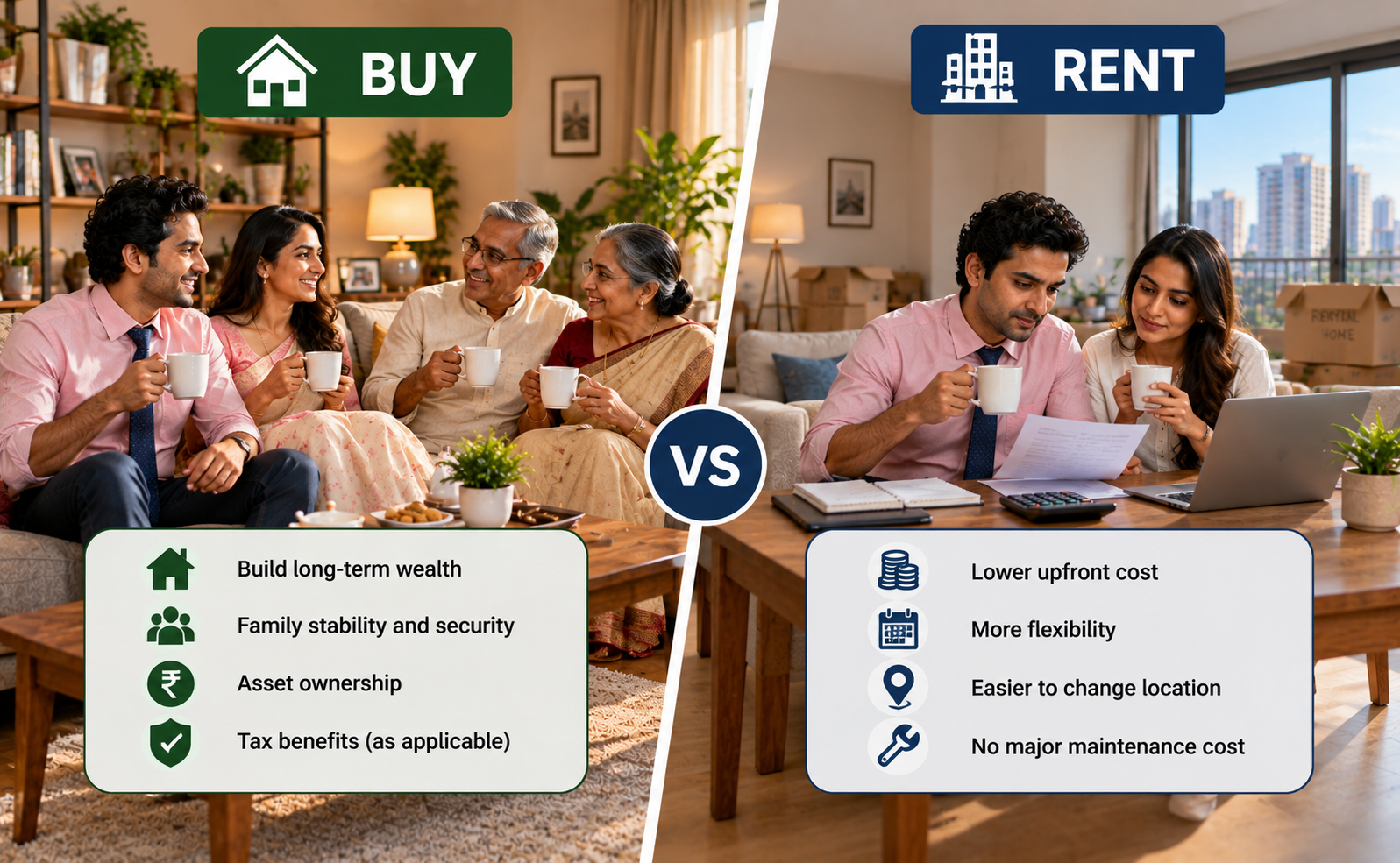
The central difference: buying a house vs renting a house combines housing consumption with property ownership, while renting provides housing without requiring the tenant to finance the entire property purchase. Neither option guarantees a better financial outcome in every situation.
What Does India’s Housing Market Tell Us in 2026?
The affordability of a home matters just as much as the desire to own one.
A 2026 SEBI-filed draft prospectus citing Redseer research reported that India’s property price-to-income ratio increased from approximately 5–5.5 in 2021 to 7.5–8 in 2025. The same analysis estimated that home-loan EMI payments represented around 50–55% of income in 2025, compared with 30–35% in 2021 under its stated assumptions. These are broad estimates, not the financial position of every Indian household. Source: SEBI-filed draft prospectus
The implication is important: a property can be attractive as a long-term asset but still be unaffordable for a particular buyer.
At the same time, India’s housing market is not moving uniformly. Aurum PropTech’s Q2 2026 report recorded 91,729 residential sales across eight major cities, down 6.1% year-on-year, while the sales-weighted average price reached ₹10,153 per square foot. City-level results differed considerably. Source: Aurum PropTech, Q2 2026
These market figures do not tell an individual whether to buy or rent. They show why decisions should account for the specific city, property, budget and holding period rather than relying on a single national rule.
The Real Cost of Buying a House in India

The purchase price is only one part of the total cost of homeownership. Buyers should account for the money needed before moving in and the expenses that continue after purchase.
1. Down payment
Home loans generally finance only part of a property’s value. The buyer must arrange the remaining amount from savings or other permitted sources.
For example, if a property costs ₹1 crore and the buyer makes a 20% down payment, the initial contribution is ₹20 lakh. The loan amount would be ₹80 lakh, before accounting for other purchase costs.
A larger down payment reduces the loan amount and EMI, but it also ties up more of the buyer’s savings.
2. Stamp duty and registration
Stamp duty and property registration charges depend on the state, property value, property type and applicable concessions. They should not be assumed to be identical across India.
For illustration, if these and other purchase-related charges together were 7% of a ₹1 crore property, they would add ₹7 lakh to the purchase budget. This is a hypothetical planning assumption, not a universal rate.
Buyers should verify the applicable charges with the relevant state registration department before committing to a purchase.
3. Home loan interest
The EMI includes both principal repayment and interest. In the early years of a typical amortising loan, a substantial share of the EMI goes towards interest.
The interest rate also matters. ICICI Bank’s published October 2026 information lists standard home-loan rates that vary according to the loan amount, customer profile and other conditions. Its published rates include a range of 8.75%–9.80% for salaried borrowers in the ₹35 lakh–₹75 lakh loan slab, subject to the bank’s terms. Actual offers can differ. Source: ICICI Bank home-loan rates
Always compare the effective rate, processing fees, reset terms for floating-rate loans and prepayment conditions—not just the headline rate.
4. Maintenance, repairs and other costs
Owners may need to pay for society maintenance, property tax, insurance where appropriate, plumbing, electrical repairs, painting and major replacements.
These costs can vary with the age, size, location and condition of the property. A newer apartment may have different maintenance needs from an older independent house.
5. The opportunity cost of your savings
Money used for a down payment cannot simultaneously be invested elsewhere.
This does not mean renting is automatically better. It means a fair comparison should consider what the buyer could have done with the down payment and what the renter could do with savings left over after paying rent.
Rent vs Buy House Calculator India: An Illustrative Financial Comparison
A useful rent-versus-buy calculation compares the full cost of owning a home with the cost of renting a comparable property—not just EMI against rent.
Consider the following hypothetical example.
Assumptions
Rent vs Buy House Calculator: Assumptions
Illustrative inputs for comparing homeownership and renting in India
| Input | Illustrative Value |
|---|---|
| Property purchase price | ₹1,00,00,000 |
| Down payment | ₹20,00,000 |
| Home loan | ₹80,00,000 |
| Loan tenure | 20 years |
| Assumed annual interest rate | 8.5% |
| Comparable monthly rent | ₹35,000 |
| Assumed annual rent increase | 5% |
| Illustrative purchase charges | 7% of property price |
These figures are assumptions for demonstrating the calculation. They are not a quotation for a specific property, a forecast of future rents or a prediction of property appreciation.
What would the home loan cost?
With a loan of ₹80 lakh over 20 years at an assumed annual interest rate of 8.5%, the approximate monthly EMI would be ₹69,400.
Home Loan Cost Breakdown
Illustrative costs for an ₹80 lakh home loan over 20 years
| Home Loan Measure | Approximate Amount |
|---|---|
| Loan principal | ₹80 lakh |
| Monthly EMI | ₹69,400 |
| Total EMIs over 20 years | ₹1.67 crore |
| Total interest over 20 years | ₹86.6 lakh |
| Down payment | ₹20 lakh |
| Purchase charges at assumed 7% | ₹7 lakh |
The total cash paid towards the down payment, purchase charges and scheduled EMIs would be approximately ₹1.94 crore over 20 years, before maintenance, property tax, repairs, insurance, furnishing, potential tax effects or loan-rate changes.
That figure is not the net economic cost of owning the home: the buyer also owns a property and gradually repays the principal. Its eventual market value, however, is uncertain.
What would renting cost?
At an initial rent of ₹35,000 per month, the first year’s rent would be ₹4.2 lakh.
If rent increased by 5% each year, the cumulative rent over 20 years would be approximately ₹1.39 crore.
This estimate assumes rent increases once each year at a constant rate. Actual rental increases depend on the city, property, agreement and market conditions.
What does the comparison show?
The buyer would need considerably more cash upfront and would have a higher scheduled monthly housing payment in this example. The renter would avoid the property purchase and loan but would continue paying rent and would not own the rented property at the end of the period.
The buyer’s financial outcome would depend partly on the property’s future value and ownership costs. The renter’s outcome would depend partly on how the down payment and any monthly savings were managed and invested.
The important lesson: neither the ₹1.94 crore ownership cash outflow nor the ₹1.39 crore cumulative rent figure, taken alone, proves which option is better. A complete comparison must include the remaining property value, outstanding loan balance, ownership costs and the value of investments made by the renter.
How Rental Yield Helps Compare Buying vs Renting House
Rental yield measures annual rent relative to a property’s purchase price. It can help explain why renting a particular property may cost much less each month than buying it.
The basic formula is:
Gross rental yield = (Annual rent ÷ Property purchase price) × 100
For example, if a property worth ₹1 crore rents for ₹35,000 per month, annual rent is ₹4.2 lakh and gross rental yield is 4.2%.
This is a gross figure. It does not deduct maintenance, vacancy, repairs, taxes or other costs, and it does not measure capital appreciation.
Residential rental yields across selected Indian cities- H1 2026
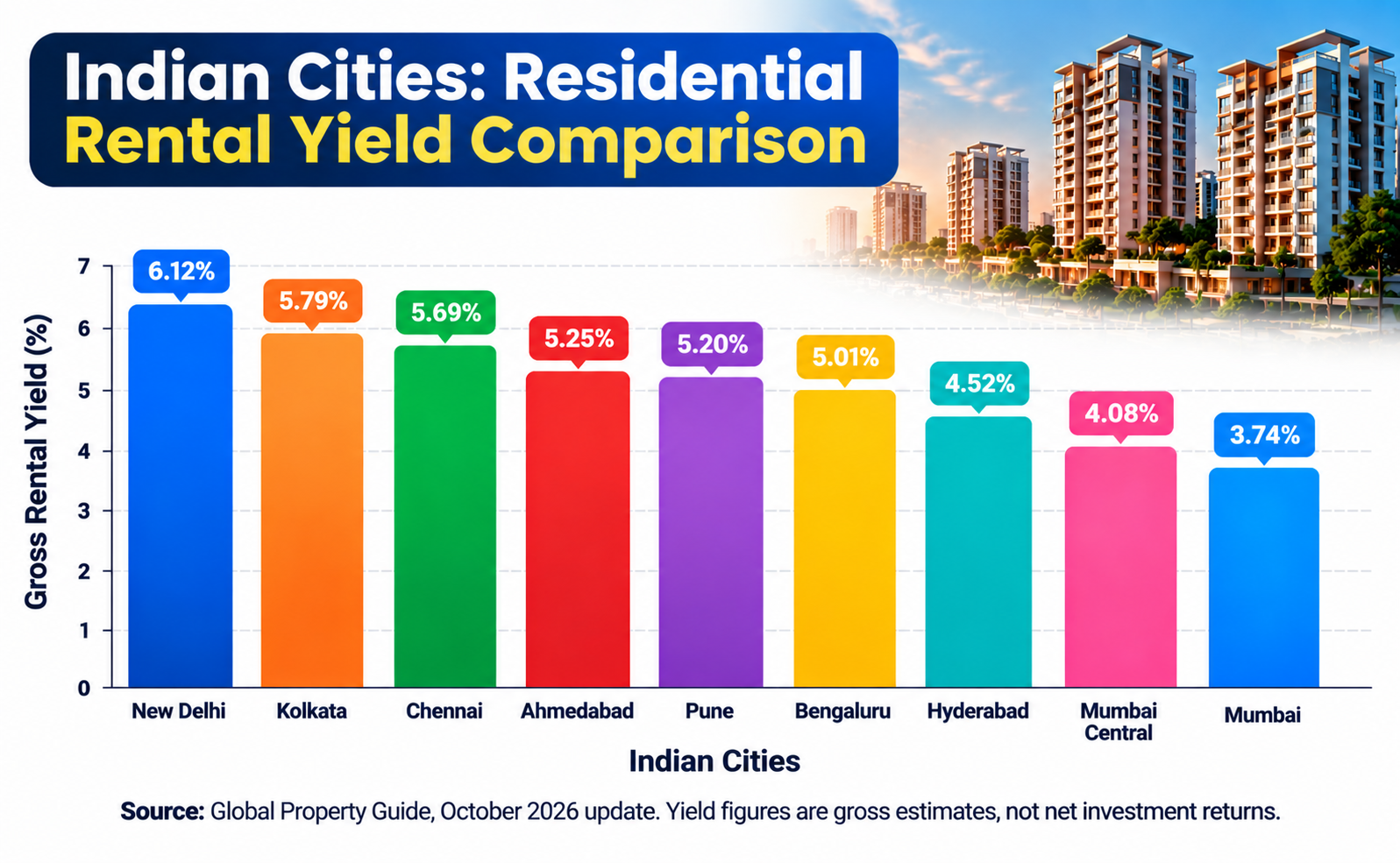
Source: Global Property Guide, October 2026 update. Figures are city-level estimates based on median asking prices and rents; they are not guaranteed yields for an individual property.
These differences matter. A property in one city or neighbourhood may generate more rent relative to its price than a similar property elsewhere. But a higher rental yield does not automatically make buying better: financing costs, maintenance, vacancy risk, property condition and future resale value also matter.
Advantages of Renting a House vs Buying
Renting can be a practical financial choice, particularly when a buyer needs flexibility or would have to stretch their finances to purchase a property.
1. Lower initial financial commitment
Renting usually requires a security deposit and moving-related costs rather than a substantial down payment, stamp duty and registration expenses.
The difference can be especially important for someone who is still building an emergency fund or saving for other major goals.
2. Flexibility to relocate
Professionals who may change jobs, move cities or work abroad can benefit from renting. It avoids the time, transaction costs and uncertainty associated with selling a home after a short stay.
3. More accessible savings for other goals
Money not committed to a property purchase can remain available for emergencies, education, retirement planning or diversified investments.
However, this benefit only materialises if the renter manages the money deliberately. Spending the entire difference between rent and EMI does not create an investment advantage.
4. Less direct responsibility for major property repairs
Depending on the agreement and applicable law, the landlord may be responsible for certain structural or major repairs. Tenants should confirm these responsibilities in writing rather than assume every repair is the landlord’s obligation.
5. Opportunity to test a neighbourhood
Renting allows a household to understand commuting times, schools, public transport, local facilities and neighbourhood conditions before committing to a purchase.
This can be especially useful when moving to a new city.
When renting may be the better choice
Renting deserves serious consideration if your income is uncertain, you may relocate within a few years, your savings are insufficient for the down payment and emergency fund, or buying would leave too little money for essential expenses.
Advantages of Buying a House Over Renting
Homeownership can provide financial and personal benefits when the purchase is affordable and suited to the buyer’s long-term plans.
1. Building equity
Each EMI generally includes principal repayment and interest. As the principal is repaid, the owner’s equity in the property can increase, assuming the property retains value.
Equity is not the same as cash in the bank. Accessing it usually requires selling, refinancing or another permitted financial arrangement.
2. Potential property appreciation
A property may appreciate over time, especially when local demand, infrastructure, employment and neighbourhood amenities support prices. But appreciation is not guaranteed, and a property can stagnate or lose value.
Buyers should avoid basing affordability on an assumption that prices will always rise rapidly.
3. Greater control over the home
Owners generally have greater freedom to renovate, personalise and plan the home, subject to building rules, society requirements and applicable laws.
Renters may need the landlord’s permission for substantial changes.
4. Greater residential stability
Owning a suitable home can provide continuity for families who expect to remain in one location for a long period. It can reduce uncertainty associated with lease renewal or relocation, although owners still face loan obligations and property-related risks.
5. A possible long-term financial asset
A fully or substantially paid-off home can reduce future housing-payment pressure compared with continuing to rent. It may also be passed on to family members, subject to applicable succession and property laws.
However, a home is an illiquid asset and may not be a substitute for an emergency fund or a diversified investment portfolio.
Is Buying Better If You Plan to Stay for Five, Ten or Twenty Years?
The length of time you expect to stay is one of the most important factors in the decision.
A short holding period can make buying less attractive because the buyer may incur substantial purchase costs and later face selling costs. Over a longer period, the buyer has more time to repay principal and potentially benefit from appreciation.
There is no universal break-even year. The result depends on the purchase price, rent, financing rate, transaction costs, maintenance, rent increases, property appreciation and the renter’s investment returns.
Use these as decision guidelines, not fixed rules:
- Short stay or uncertain location: renting often offers greater flexibility.
- Medium-term stay: compare the full costs using realistic assumptions before deciding.
- Long-term stay with stable finances: buying may be attractive if the property is fairly priced and the EMI is comfortably affordable.
Do not assume that staying for five or ten years automatically makes buying financially superior. Run the numbers for your circumstances.
How to Make a Fair Rent vs Buy House Calculator India
A useful comparison should evaluate both options over the same period.
The buying scenario should include
- Down payment and transaction charges
- Home loan EMI, separating principal and interest where possible
- Maintenance, repairs, property tax and insurance where applicable
- Furnishing and major replacement costs
- Outstanding loan balance at the end of the comparison period
- Estimated property resale value, using conservative scenarios
- Selling costs and applicable taxes where relevant
The renting scenario should include
- Initial rent and expected increases
- Security deposit and any brokerage or moving costs
- Renters’ maintenance responsibilities under the agreement
- The down payment and purchase charges that remain available to invest
- Any monthly difference between the cost of renting and owning
- Investment returns after costs and applicable taxes
A rent-vs-buy calculator can organise these assumptions, but its output is only as reliable as the inputs. Try a conservative, moderate and optimistic property-price scenario rather than relying on a single forecast.
Should You Invest the Money Saved by Renting?
This is one of the most overlooked parts of the buying-versus-renting decision.
Suppose renting costs ₹35,000 a month while the owner’s EMI is approximately ₹69,400. The initial difference is ₹34,400 per month, before considering the owner’s maintenance costs and the renter’s other expenses.
A disciplined renter could invest some or all of the difference, as well as the money not used for the down payment and purchase charges. Over time, that portfolio could grow.
But three cautions matter:
- The difference will change: rent may rise, while a floating-rate home loan EMI or tenure may also change.
- Returns are uncertain: investments can lose value, and taxes and fees affect the outcome.
- Discipline matters: if the renter spends the difference instead of investing it, the expected investment advantage may not materialise.
Likewise, a homeowner’s financial outcome depends on more than the property’s value. The owner must afford the loan, maintain the home and keep sufficient liquid savings.
How Much EMI Can You Afford?
Before buying, test the EMI against your household’s take-home income rather than judging affordability solely by the bank’s loan approval.
For example, a ₹69,400 EMI would consume about 35% of a ₹2 lakh monthly take-home income, but nearly 58% of a ₹1.2 lakh income. These are simple illustrations and exclude maintenance, property tax, insurance, other debt and household spending.
A buyer should consider:
- Stable income and job prospects
- Existing EMIs and other debts
- Essential monthly household expenses
- Emergency savings after the down payment
- Education, healthcare and retirement goals
- The possibility of higher loan payments if the rate changes
An EMI that leaves no room for emergencies can turn homeownership into a financial burden even if the property is a good long-term asset.
Home Loan Tax Benefits: Check the Rules Before Assuming Savings
Some homebuyers may qualify for tax benefits associated with home-loan interest or principal repayment, depending on the applicable provisions, property use, loan circumstances and chosen tax regime.
Do not treat a tax deduction as automatic. Eligibility and the practical benefit can differ, particularly under different tax regimes and for self-occupied versus let-out properties.
Verify current rules through official tax guidance or a qualified tax professional before including tax savings in a rent-versus-buy calculation. A financial comparison should remain sensible even if an expected tax benefit is unavailable.
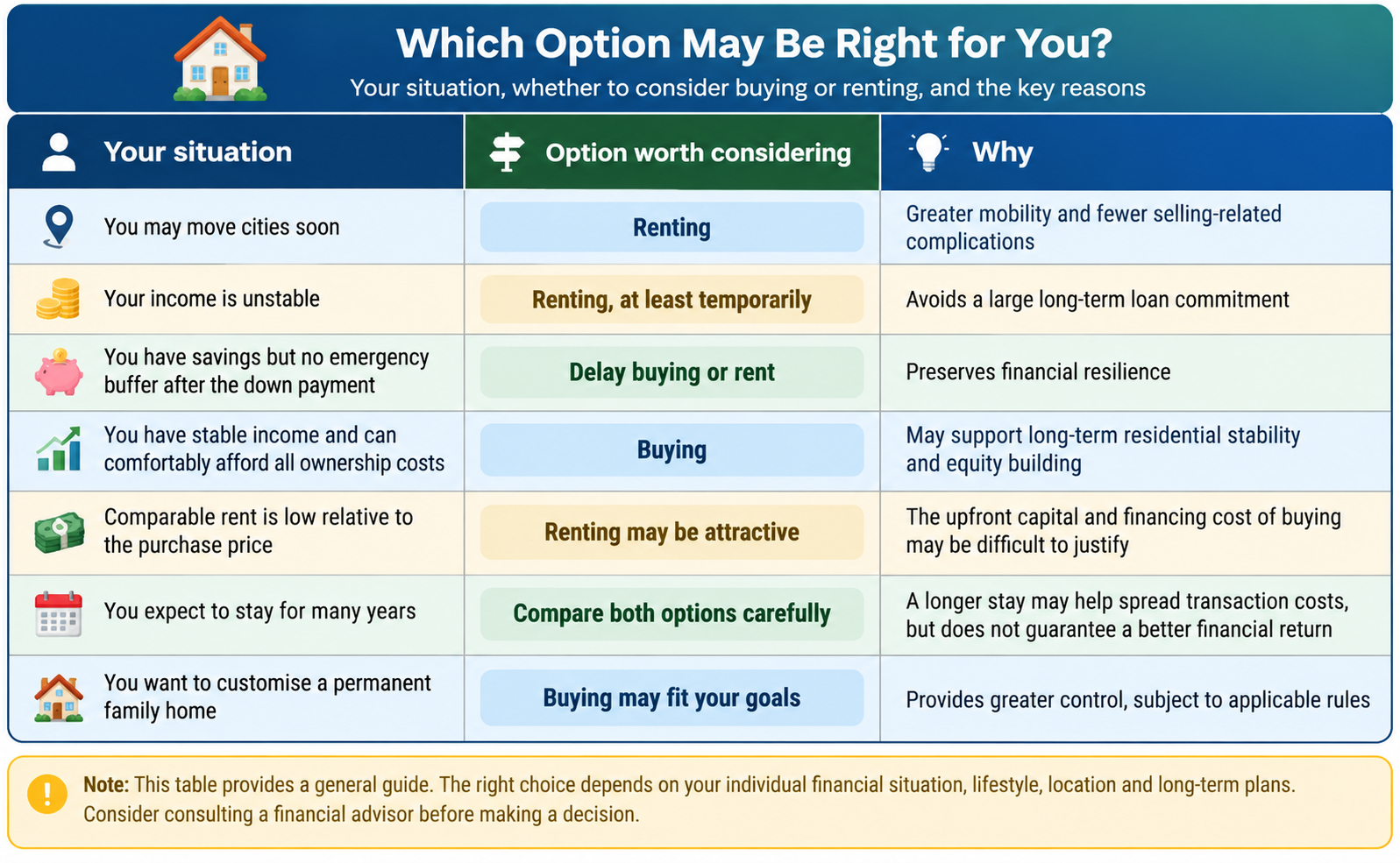
Buying vs Renting a Home in India: Which Option Is Right for You?
There is no single answer for every Indian household. The best choice depends on the interaction between finances, location, lifestyle and time horizon.
A Practical Checklist Before You Decide
Before signing a rental agreement or committing to a home loan, answer these questions:
- Can I afford the down payment and purchase charges without exhausting my emergency savings?
- Have I compared rent with the full cost of ownership—not just the EMI?
- How long am I realistically likely to stay in this location?
- Have I checked the property’s legal status, condition and local market price?
- Have I tested the calculation with lower property appreciation and higher maintenance costs?
- If I rent, will I invest the money that remains available?
- Will the decision still be manageable if my income falls or my expenses rise?
If several answers remain uncertain, renting while strengthening your finances may be a sensible temporary choice. If the numbers work, your income is stable and the property meets your long-term needs, buying may be appropriate.
Frequently Asked Questions (FAQ)
Is buying vs renting house better in India in 2026?
It depends on the property price, rent, home-loan rate, household income, expected length of stay and alternative investment opportunities. Buying can provide ownership and stability, while renting can preserve flexibility and capital. Compare both options using realistic local figures.
What is the biggest financial advantage of renting?
Renting generally requires a lower initial financial commitment than purchasing a property. The money not spent on a down payment and purchase charges may remain available for emergencies or investments, provided it is managed responsibly.
What is the biggest advantage of buying a house?
Buying can build equity as the loan principal is repaid and may provide long-term residential stability. Property appreciation is possible but not guaranteed, and the owner must account for interest, maintenance and other costs.
Does paying rent mean wasting money?
No. Rent pays for the use of a home and provides flexibility without requiring the tenant to finance the full purchase price. Whether renting is financially preferable depends on what buying would cost and how the renter manages the money that remains available.
Is EMI always better than rent?
No. An EMI includes principal and interest, but the owner also pays purchase charges and ongoing ownership costs. Rent may be lower than the EMI for a comparable property. A fair comparison includes equity, the property’s future value, transaction costs and investment alternatives.
How do I calculate Buying vs renting house ?
Compare the total cost of ownership over a chosen period with cumulative rent over the same period. Include the down payment, purchase charges, loan interest, maintenance, resale value and remaining loan balance. For renting, include rent increases and the potential returns on money not used to buy.
What is rental yield, and why does it matter?
Gross rental yield is annual rent divided by the property’s purchase price, expressed as a percentage. It helps compare rent relative to property prices across locations, but it excludes operating costs and does not predict future appreciation.
Should first-time homebuyers buy a house or rent first?
Renting can help first-time buyers learn a city, build savings and understand their housing needs before making a large commitment. Buying may be suitable once the buyer has stable finances, adequate emergency savings and a property that fits their long-term plans.
Final Verdict: Make the Decision With Your Numbers
The buying vs renting house debate is not about proving that one option is always right. It is about choosing the housing arrangement that best fits your finances and future plans.
Buying can provide ownership, stability and potential long-term equity, but it requires substantial capital and a commitment to ongoing costs. Renting can offer flexibility, lower upfront expenses and the opportunity to invest elsewhere, but the tenant does not build equity in the rented property.
Before making a decision, compare the complete costs, test different market scenarios and assess how much financial flexibility you need.
The smartest housing decision is not necessarily to buy as soon as possible or rent forever. It is to choose an option you can afford comfortably and sustain over the long term.
Also read this latest article- Property Buying Checklist India : 7 Essential Checks for First-Time Home buyer India in 2026
Disclaimer: This article provides general educational information, not individual financial, legal or tax advice. Market data, interest rates and tax rules can change. Verify current details and consult an appropriate professional before making a major property or investment decision.